Daily Kilojoule & Calorie Calculator
Uses the Mifflin-St Jeor equation. An estimate only, not medical advice.
On this page
How Many Kilojoules Do You Need A Day?
Most adults need somewhere between 6,500 and 12,500 kJ a day (about 1,550-3,000 Calories). Where you sit in that range depends on your body size, age, sex and, more than anything else you can control, how much you move.
The calculator above gives you a personal estimate in a few seconds. It works out your basal metabolic rate (the energy your body uses at complete rest), multiplies it by an activity factor, and shows the result in both kilojoules and Calories. It then suggests intakes for gentle weight loss, standard weight loss and weight gain.
8,700 kJ is an average, not a target. The number printed on Australian and New Zealand labels is a reference for the “% daily intake” column. A tall, active man may need 12,000 kJ or more; a small, sedentary older woman may need under 7,000 kJ.
How The Daily kJ Calculator Works
Step 1: Basal Metabolic Rate (BMR)
BMR is the energy needed to keep you alive at rest, breathing, circulation, brain function, keeping warm, repairing cells. For most people it’s 60-70% of total daily energy use. We estimate it with the Mifflin-St Jeor equation, which studies have found to be one of the most accurate simple formulas for adults:
Mifflin-St Jeor (In Calories)
Men: BMR = 10 × weight (kg) + 6.25 × height (cm) − 5 × age + 5
Women: BMR = 10 × weight (kg) + 6.25 × height (cm) − 5 × age − 161
Then × 4.184 to convert to kJ.
Step 2: Activity Factor
Your BMR is then multiplied by a factor that reflects how active you are:
| Activity level | Description | Multiplier |
|---|---|---|
| Sedentary | Desk job, little or no planned exercise | × 1.2 |
| Lightly active | Light exercise 1-3 days a week | × 1.375 |
| Moderately active | Moderate exercise 3-5 days a week | × 1.55 |
| Very active | Hard exercise 6-7 days a week | × 1.725 |
| Extra active | Physical job plus training, or twice-daily training | × 1.9 |
The result is your total daily energy expenditure (TDEE): the energy you use in a typical day, and so roughly what you need to eat to keep your weight stable.
Step 3: Weight Change Targets
To lose or gain weight you shift your intake away from TDEE:
- Mild loss: about 1,050 kJ (250 kcal) a day below maintenance, around 0.25 kg a week.
- Weight loss: about 2,100 kJ (500 kcal) a day below maintenance, around 0.5 kg a week.
- Weight gain: about 1,050 kJ (250 kcal) a day above maintenance, a lean, gradual gain.
The calculator never suggests going below about 5,000 kJ (1,200 kcal) for women or 6,300 kJ (1,500 kcal) for men, because intakes lower than that make it very hard to get enough nutrients without medical supervision.
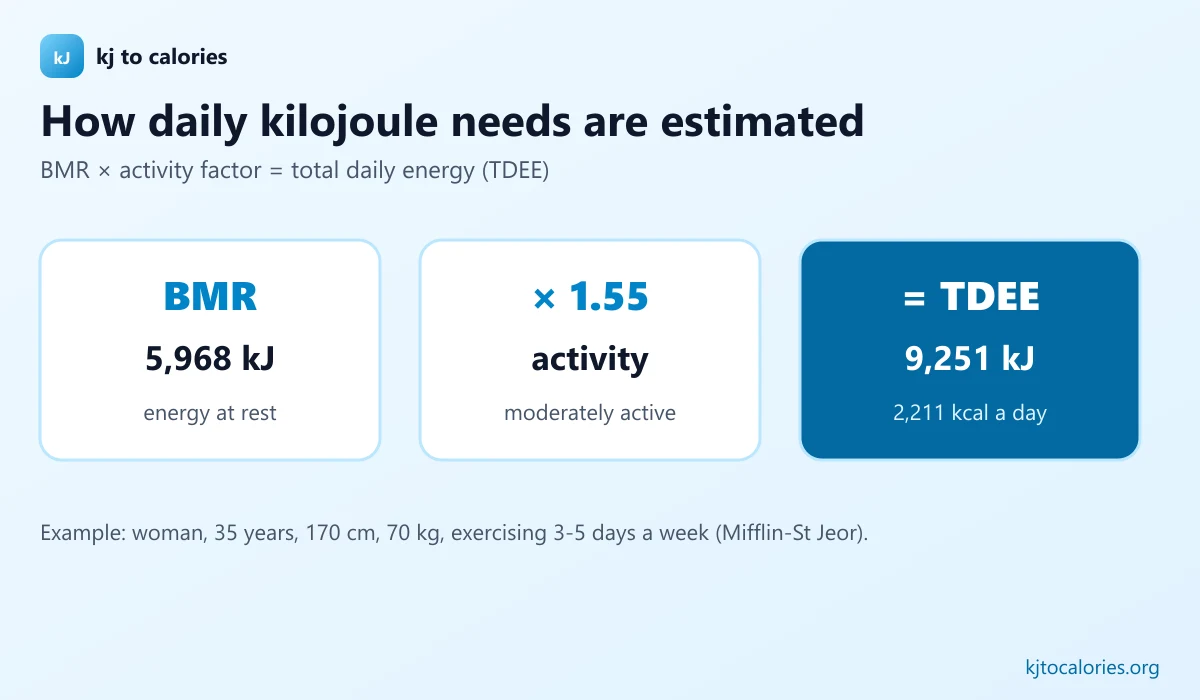
Worked Example
Take a 35-year-old woman who is 170 cm tall, weighs 70 kg and exercises 3-5 times a week.
- BMR = 10 × 70 + 6.25 × 170 − 5 × 35 − 161 = 700 + 1,062.5 − 175 − 161 = 1,426.5 kcal
- TDEE = 1,426.5 × 1.55 = 2,211 kcal
- In kilojoules: 2,211 × 4.184 = 9,251 kJ a day to maintain her weight.
- For steady weight loss she might aim for about 2,211 − 500 = 1,711 kcal, or 7,159 kJ a day.
That’s why the calculator shows 9,251 kJ when you first open it, those are its default values.
Typical Daily kJ Needs By Age And Sex
These estimates are based on the ranges published in the US Dietary Guidelines for Americans, converted to kilojoules and rounded. They assume average height and weight for each group.
| Age | Women, sedentary | Women, active | Men, sedentary | Men, active |
|---|---|---|---|---|
| 19-30 | 7,500-8,400 kJ | 10,000 kJ | 10,000-10,900 kJ | 12,600 kJ |
| 31-50 | 7,500 kJ | 9,200 kJ | 9,200-10,000 kJ | 11,700-12,600 kJ |
| 51-60 | 6,700 kJ | 9,200 kJ | 9,200 kJ | 10,900-11,700 kJ |
| 61+ | 6,700 kJ | 8,400 kJ | 8,400 kJ | 10,000-10,900 kJ |
A few patterns stand out. Energy needs peak in early adulthood and drift down gradually after that, largely because muscle mass tends to fall with age. Active people of any age need significantly more. And men generally need more than women because, on average, they are larger and carry more muscle.
What Changes How Many Kilojoules You Need?
- Body size. A bigger body uses more energy to run and to move.
- Muscle mass. Muscle is more metabolically active than fat, so two people of the same weight can have different needs.
- Age. Needs decline slowly through adulthood.
- Activity. Planned exercise and everyday movement, walking, standing, housework, fidgeting, which researchers call NEAT.
- Pregnancy and breastfeeding. Needs rise, particularly in the second and third trimesters and while breastfeeding. Ask your midwife or doctor for guidance.
- Illness, injury and recovery. Fever, healing wounds and some medical conditions raise energy use.
- Climate. Extreme cold slightly raises needs; the effect is small in heated homes.
How Accurate Is A Daily kJ Calculator?
Any equation is an estimate. Mifflin-St Jeor predicts resting energy use within about 10% for most healthy adults, but individuals can fall outside that. The bigger source of error is usually the activity level people choose, most of us overestimate how active we are.
The best approach is to treat the result as a starting point:
- Eat roughly the suggested amount for two to three weeks.
- Track your weight a few times a week and look at the trend, not single days.
- If your weight is stable, you’ve found your maintenance. If it’s moving in a direction you didn’t intend, adjust by 500-1,000 kJ a day and reassess.
Turning Your Daily kJ Into Meals
Once you know your target, splitting it across the day makes it practical. For a 9,000 kJ day:
| Meal | Share | Kilojoules | Calories |
|---|---|---|---|
| Breakfast | 25% | 2,250 kJ | 538 kcal |
| Lunch | 30% | 2,700 kJ | 645 kcal |
| Dinner | 35% | 3,150 kJ | 753 kcal |
| Snacks & drinks | 10% | 900 kJ | 215 kcal |
| Total | 100% | 9,000 kJ | 2,151 kcal |
Use the food kJ chart to see what fits into each budget, and the food label calculator to check packaged foods.
Kilojoules For Weight Loss: What’s Realistic?
A deficit of about 2,100 kJ (500 Calories) a day is the classic rule of thumb for losing about half a kilogram a week, because a kilogram of body fat stores roughly 32,200 kJ (7,700 Calories). In practice weight loss is rarely that linear: early losses include water, and your energy needs fall as you get lighter. Recalculate every few kilograms.
Very low intakes can backfire. They make it hard to get enough protein, fibre, vitamins and minerals, increase muscle loss, and are hard to sustain. Read our guide to how many kJ to eat to lose weight for a fuller picture.
Important: This calculator is for healthy adults and gives general estimates only. It isn’t suitable for children, pregnant or breastfeeding women, elite athletes, or people with medical conditions affecting weight or metabolism. Please speak to a doctor or accredited dietitian for personal advice.
Related Tools
- kJ to calories converter
- Calories to kJ converter
- Macros to kJ calculator
- Exercise kJ burn calculator
- What is 8,700 kJ?
- How many kJ to lose weight
- BMR kJ to calories
- Australia & NZ converter
Daily Kilojoules FAQ
How many kJ should an adult eat per day?
Most adults need between about 6,500 and 12,500 kJ a day. The 8,700 kJ figure on Australian and New Zealand labels is an average used for comparison, not a personal target. Use the calculator above for an estimate based on your details.
How many kJ a day should a woman eat?
Many adult women need roughly 6,700-10,000 kJ (1,600-2,400 Calories) a day depending on age, size and activity. Smaller, older or less active women are at the lower end.
How many kJ a day should a man eat?
Many adult men need roughly 8,400-12,600 kJ (2,000-3,000 Calories) a day, with younger and more active men at the upper end.
How many kJ should I eat to lose weight?
A common approach is to eat about 1,000-2,100 kJ (250-500 Calories) a day less than your maintenance intake. The calculator shows both levels for you.
Is 5,000 kJ a day enough?
5,000 kJ (about 1,200 Calories) is below what most adults need and is generally only used for weight loss under professional guidance. Going lower makes it very difficult to meet nutrient needs.
What is BMR in kJ?
Basal metabolic rate is the energy your body uses at complete rest. For most adults it’s roughly 5,000-8,000 kJ a day. The calculator shows yours under the main result.
Does the calculator work in pounds and feet?
Yes. Tap “Imperial” to enter weight in pounds and height in feet and inches. Results are always shown in both kJ and Calories.