If you’ve ever looked at a food label and seen “kJ”, “kcal”, “Cal” or “Calories”, you’re not alone in wondering whether they’re the same thing. They all measure energy, but on different scales, and one of them hides a factor of 1,000.
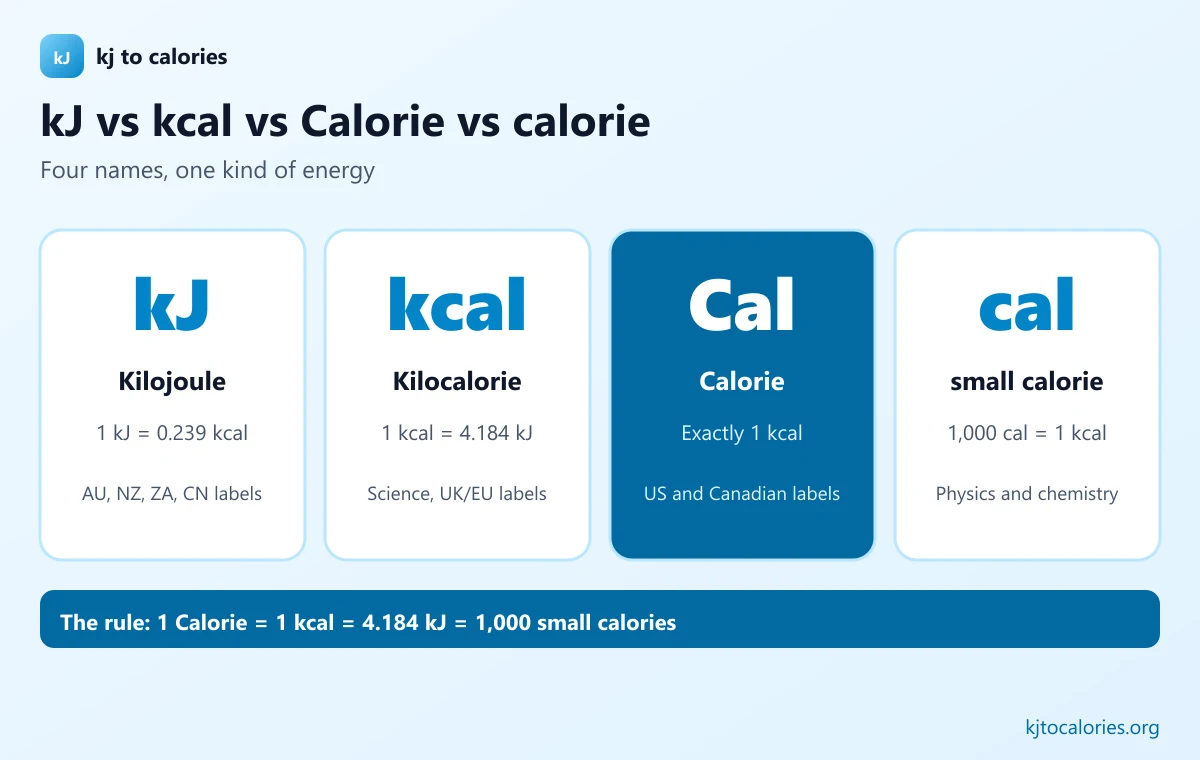
The short answer: 1 Calorie (capital C) = 1 kcal = 4.184 kJ. The only unit that’s different is the small “cal”, which is 1,000 times smaller than a Calorie.
On this page
The Four Units At A Glance
| Unit | Symbol | Equals | Where you’ll see it |
|---|---|---|---|
| Kilojoule | kJ | 1,000 joules; 0.239 kcal | Food labels in Australia, NZ, South Africa, China; alongside kcal in the UK and EU |
| Kilocalorie | kcal | 1,000 small calories; 4.184 kJ | Nutrition science, UK/EU labels, diet apps |
| Calorie (capital C) | Cal | Exactly 1 kcal | US and Canadian labels, everyday speech |
| calorie (small c) | cal | 4.184 joules; 0.001 kcal | Physics and chemistry textbooks |
What Is A Kilojoule?
The joule (J) is the international (SI) unit of energy, named after the English physicist James Prescott Joule, who showed in the 1840s that heat and mechanical work are forms of the same thing. One joule is a tiny amount, roughly the energy needed to lift a small apple one metre. Food contains so many joules that we count them in thousands: 1 kilojoule (kJ) = 1,000 joules.
Because the joule is the standard scientific unit, countries that fully adopted the metric system for food labelling, Australia, New Zealand and South Africa among them, print energy in kilojoules.
What Is A Calorie?
The calorie is older. It was defined in the 19th century as the heat needed to raise the temperature of water by one degree Celsius. There were two versions:
- the small calorie (cal): 1 gram of water by 1 °C;
- the large calorie, or kilocalorie (kcal): 1 kilogram of water by 1 °C, 1,000 times bigger.
When nutrition scientists such as Wilbur Atwater began measuring the energy in food in the late 1800s, they used the large calorie. Over time, popular writing shortened “kilocalorie” to “Calorie”, sometimes with a capital C to mark it as the large unit, and often without. So when a US label says a snack has “150 Calories”, it means 150 kilocalories.
Today the calorie is defined in terms of the joule. The thermochemical calorie, used for food energy, is exactly 4.184 joules, which gives the familiar 1 kcal = 4.184 kJ.
So Is A Calorie The Same As A kcal?
Yes. On food labels, in diet apps and in nutrition research, Calorie = kcal. Some labels write “Cal”, some “Calories”, some “kcal”, all identical.
The only trap is the lower-case “cal” in science contexts. If you ever see a food listed at “250,000 cal”, that’s 250 kcal written in small calories. You’ll rarely see this outside a textbook.
How To Convert Between kJ And Calories
Conversion Formulas
Calories = kJ ÷ 4.184
kJ = Calories × 4.184
Some quick examples:
- 500 kJ ÷ 4.184 = 119.5 Calories
- 1,000 kJ ÷ 4.184 = 239 Calories
- 250 Calories × 4.184 = 1,046 kJ
- 2,000 Calories × 4.184 = 8,368 kJ
Or skip the maths with our kJ to calories converter and calories to kJ converter.
Mental Shortcuts
- kJ → Calories: divide by 4, then take off about 4%. (1,000 kJ → 250 → 240. Exact: 239.)
- Calories → kJ: multiply by 4, then add about 5%. (300 Cal → 1,200 → 1,260. Exact: 1,255.)
Which Countries Use Which Unit?
Australia, New Zealand, South Africa and China use kJ; the UK and EU show both; the US and Canada use Calories.
If you move between these systems, through travel, online shopping or apps designed in another country, you’ll need to convert. Our guide on why some countries use kilojoules covers the history.
Does It Matter Which Unit I Use?
Not for your health. A kilojoule and a Calorie measure exactly the same energy; they’re like kilometres and miles. What matters is that you stick to one unit when tracking, so you don’t accidentally compare a kJ figure with a Calorie target.
- If your local labels are in kJ, it’s often easiest to set your tracking app to kJ too.
- If you follow a Calorie-based plan, convert your target once (for example, 1,800 Calories = 7,531 kJ) and work in kJ from then on.
Common Mix-Ups
- Comparing a kJ label with a Calorie target. A 1,000 kJ snack isn’t a 1,000-Calorie snack, it’s 239 Calories.
- Converting twice on UK/EU dual labels that already show both units.
- Thinking kcal is “bigger” than Calories. They’re equal.
- Using 4.2 or 4 as exact factors. Fine for estimates; 4.184 is correct.
Key Takeaways
- Kilojoules and Calories both measure energy.
- 1 Calorie = 1 kcal = 4.184 kJ.
- Labels differ by country, not because the food is different.
- Pick one unit for tracking and convert once.
Try it now with the kJ to calories converter or look up common foods in the food kJ chart.
FAQ
Is 1 kJ the same as 1 Calorie?
No. 1 Calorie is 4.184 kJ, so a kilojoule is about a quarter of a Calorie (0.239 Cal).
Why do US labels say Calories but Australian labels say kJ?
The US never fully adopted the metric system for everyday use and kept the traditional Calorie. Australia and New Zealand adopted the SI unit, the joule, during metrication.
What does kcal stand for?
Kilocalorie, 1,000 small calories. It’s the same as a food Calorie.
Which is more accurate, kJ or Calories?
Neither. They’re different units for the same quantity, and each converts exactly into the other.
What is kJ compared to Calories?
A kilojoule is about a quarter of a Calorie: 1 kJ = 0.239 Calories, and 1 Calorie = 4.184 kJ.
How much is 1 kJ in Calories?
1 kJ is 0.239 Calories (kcal). So 1,000 kJ is 239 Calories.
Is kJ equal to Calories?
No. They measure the same thing, energy, but a Calorie is 4.184 times bigger than a kilojoule.