Food Label Energy Calculator
On this page
How To Use The Food Label Calculator
- Find the energy per 100 g (or per 100 ml for drinks) on the nutrition panel. Choose whether your label shows kJ or kcal.
- Weigh or estimate how much you’ll eat in grams or millilitres.
- Check your daily target. It starts at 8,700 kJ, the average adult reference, but you can type your own from the daily kJ calculator.
The calculator instantly shows the kilojoules and Calories in your portion, the per-100 g values in both units, the energy density of the food, and what percentage of your daily target that portion uses.
Label Maths
Energy in your portion = energy per 100 g ÷ 100 × grams eaten
Then ÷ 4.184 to turn kJ into Calories.
Worked Example: A Bag Of Chips
A bag of potato chips says Energy per 100 g: 2,240 kJ. You eat a 45 g bag.
- 2,240 ÷ 100 = 22.4 kJ per gram
- 22.4 × 45 = 1,008 kJ
- 1,008 ÷ 4.184 = 241 Calories
- 1,008 ÷ 8,700 = 11.6% of an average day
More Worked Examples: Real Foods And Portions
| Food | Label (per 100 g/ml) | Portion eaten | Kilojoules | Calories |
|---|---|---|---|---|
| Greek yoghurt | 390 kJ | 170 g tub | 663 kJ | 158 kcal |
| Wholegrain cereal | 1,560 kJ | 45 g bowl | 702 kJ | 168 kcal |
| Milk on the cereal | 268 kJ | 125 ml | 335 kJ | 80 kcal |
| Frozen pizza | 1,000 kJ | half a pizza, 200 g | 2,000 kJ | 478 kcal |
| Soft drink | 180 kJ | 600 ml bottle | 1,080 kJ | 258 kcal |
| Muesli bar | 1,790 kJ | 32 g bar | 573 kJ | 137 kcal |
| Cheddar cheese | 1,690 kJ | 2 slices, 40 g | 676 kJ | 162 kcal |
| Peanut butter | 2,600 kJ | 1 tbsp, 16 g | 416 kJ | 99 kcal |
Notice how the cereal plus milk is 1,037 kJ (248 kcal), the milk adds nearly half as much again. Always add what goes with a food.
Why Use “Per 100 g” Instead Of “Per Serve”?
Nutrition panels in Australia, New Zealand, the UK and the EU show energy both per serve and per 100 g (or 100 ml). They do different jobs:
- Per 100 g lets you compare products fairly, because the amount is always the same. It’s the column to use when choosing between two brands of yoghurt, cereal or bread.
- Per serve is the manufacturer’s suggested portion. It’s convenient, but serving sizes vary between brands and often don’t match what people really eat.
Using per-100 g values with your real portion weight is the most accurate way to track energy. That’s what this calculator is built for.
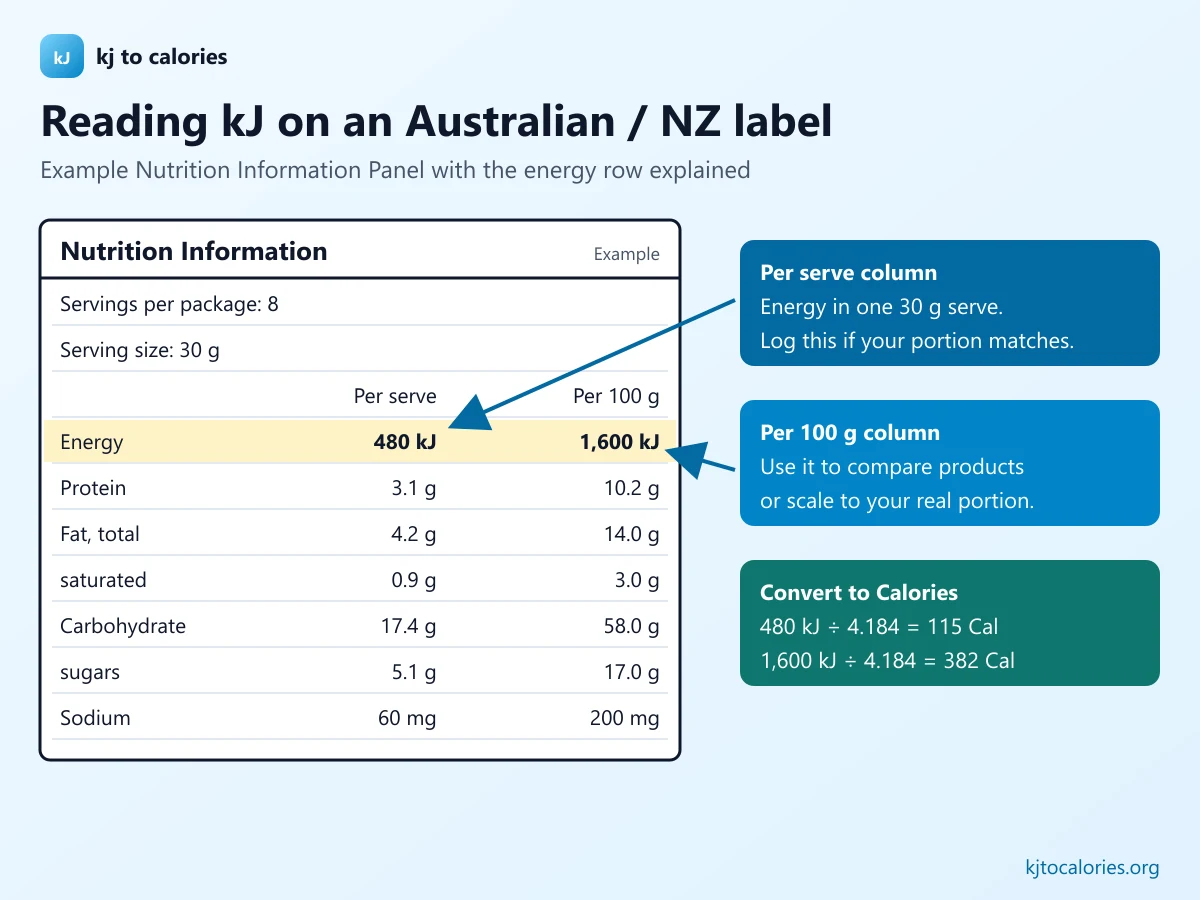
How To Read The Energy Line On Labels Around The World
Australia And New Zealand
The panel lists Energy in kJ, per serve and per 100 g. Some brands add Calories in brackets. Many packs also carry a front-of-pack Health Star Rating and a “% Daily Intake” figure based on 8,700 kJ.
United Kingdom And European Union
The panel shows Energy as both kJ and kcal, per 100 g and often per portion, e.g. Energy 1,569 kJ / 375 kcal. Front-of-pack “traffic light” labels in the UK show energy as a percentage of 8,400 kJ / 2,000 kcal.
United States And Canada
The Nutrition Facts panel shows Calories per serving in large type. There’s usually no per-100 g column, so look at the serving size in grams and scale from there.
Everywhere Else
Many countries follow either the EU-style or the US-style layout. If you see only kJ, use this calculator with “Label shows kJ”; if only kcal, switch it to “Label shows kcal”.
For a full walk-through with examples, read our guide on how to read kJ on nutrition labels.
What Is Energy Density?
Energy density is how much energy a food packs into each gram. It’s a handy way to see which foods fill you up for fewer kilojoules.
| Energy density | kJ per gram | kJ per 100 g | Examples |
|---|---|---|---|
| Very low | under 2.5 | under 250 | Most vegetables, broth soups, berries, watermelon |
| Low | 2.5-6 | 250-600 | Fruit, yoghurt, cooked grains, legumes, lean fish |
| Medium | 6-16 | 600-1,600 | Bread, lean meat, eggs, cheese sauce, pasta dishes |
| High | over 16 | over 1,600 | Crisps, chocolate, biscuits, nuts, oils, butter |
Filling your plate with low-density foods, vegetables, fruit, legumes, soups, lets you eat satisfying volumes while keeping total kilojoules in check. High-density foods aren’t off-limits; they’re just easy to over-serve.
Label Reading Mistakes To Avoid
- Reading “per serve” as “per pack”. A 200 g packet that says “4 serves per pack” contains four times the per-serve energy.
- Assuming the serving size is yours. A “serve” of breakfast cereal is often 30-45 g; many people pour 60-90 g.
- Forgetting what’s added. Milk on cereal, oil in the pan, sauce on pasta. Add them separately.
- Mixing up kJ and kcal on dual-unit labels. The kJ number is always the larger one.
- Using the dry weight for cooked food. Rice, pasta and oats absorb water. If the label is for dry product, weigh before cooking.
Useful kJ Per 100 g Reference Values
| Food | kJ per 100 g | kcal per 100 g |
|---|---|---|
| Cucumber | 63 kJ | 15 kcal |
| Apple | 218 kJ | 52 kcal |
| Cooked white rice | 544 kJ | 130 kcal |
| Wholemeal bread | 1,046 kJ | 250 kcal |
| Cheddar cheese | 1,690 kJ | 404 kcal |
| Potato chips | 2,243 kJ | 536 kcal |
| Milk chocolate | 2,218 kJ | 530 kcal |
| Almonds | 2,423 kJ | 579 kcal |
| Olive oil | 3,699 kJ | 884 kcal |
Related Tools
- kJ to calories converter
- Macros to kJ calculator
- Food kJ chart
- How to read kJ on labels (annotated)
- Daily kJ calculator
- Australia & NZ labels
Food Label FAQ
How do I work out kJ per serve from kJ per 100 g?
Divide the per-100 g figure by 100 to get kJ per gram, then multiply by the grams in your serve. For example, 1,500 kJ per 100 g × 60 g ÷ 100 = 900 kJ.
How do I convert kJ per 100 g to calories?
Divide the kJ per 100 g by 4.184. For example, 2,000 kJ per 100 g ÷ 4.184 = 478 Calories per 100 g.
What does % daily intake mean on a food label?
It’s the share of an average adult’s daily energy (8,700 kJ in Australia and New Zealand, 8,400 kJ / 2,000 kcal in the UK and EU) that one serve provides. Your personal needs may be higher or lower.
Is a high-kJ food always unhealthy?
No. Nuts, olive oil, avocado and oily fish are energy-dense but very nutritious. Energy tells you how much fuel is in a food, not its overall quality.
What is a low-kJ food?
As a rule of thumb, foods under about 400 kJ per 100 g (roughly 100 Calories) are low in energy, most vegetables, fruit, broth-based soups and plain yoghurt fall into this group.