Kilojoules to Calories Converter
Exercise times are estimates for a 70 kg adult.
On this page
KJ To Calories: The Quick Answer
This kJ to calories converter gives you the answer in one step. To convert kilojoules to calories, divide the kilojoule figure by 4.184. One kilojoule equals 0.239 Calories (kcal), and one Calorie equals 4.184 kilojoules. So 1,000 kJ is 239 Calories, 500 kJ is 119.5 Calories, and the familiar 8,700 kJ “average adult day” is about 2,079 Calories.
The converter above does the maths for you. Type a kJ value, from a nutrition panel, a menu board, your smartwatch or a recipe, and you get the calorie equivalent straight away, rounded to two decimal places. It also shows the working, the share of an average day’s energy intake, and roughly how many minutes of walking, running or cycling it would take to use that energy. Press Switch to go the other way and turn Calories into kilojoules.
The kJ To kcal Formula
Calories (kcal) = kilojoules (kJ) ÷ 4.184
Kilojoules (kJ) = Calories (kcal) × 4.184
Shortcut: kcal ≈ kJ × 0.239
We use the internationally agreed factor of exactly 4.184 kJ per kcal, the same factor used on food labels in Australia, New Zealand, the UK and the European Union, and in the scientific literature. No rounding tricks, no hidden adjustments. You can read more about who runs kj to calories and how we check our numbers.
How To Convert kJ To Calories: Infographic
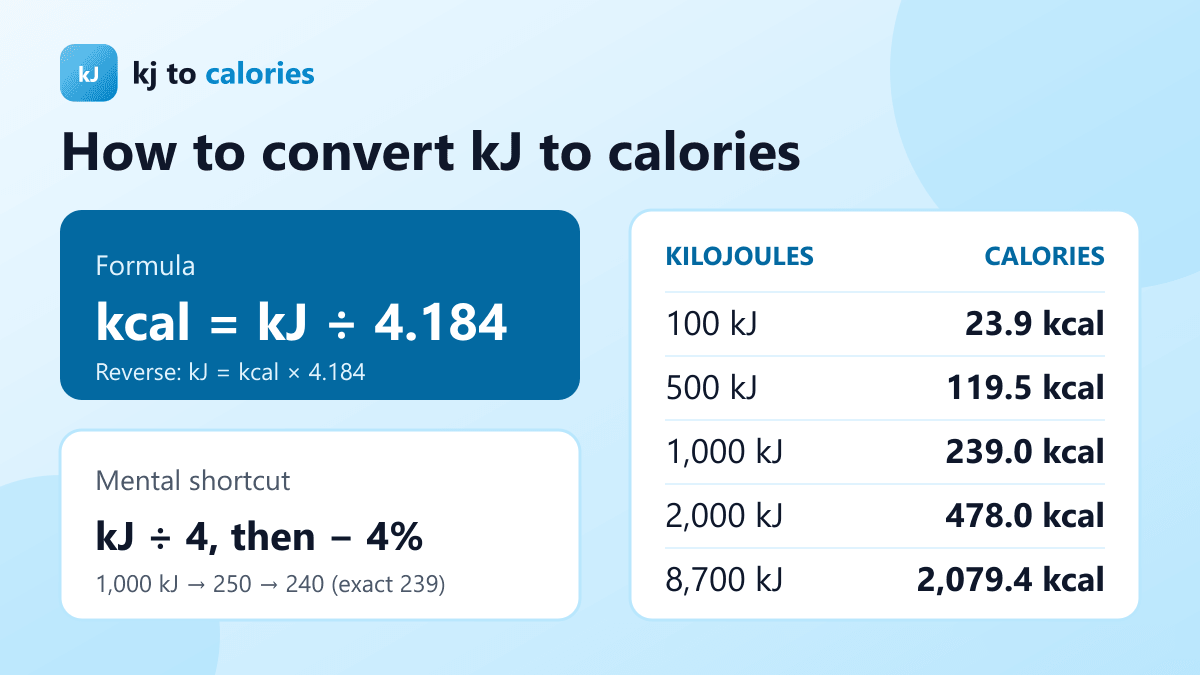
The infographic sums it up: divide by 4.184 for the exact answer, or divide by 4 and take off 4% for a quick estimate. Save it or share it, it works for any food label, fitness app or recipe.
How To Convert kJ To Calories, Step By Step
You don’t need a calculator app to do this, but it helps to see the steps once so you know the result is right.
- Find the energy figure in kilojoules. On a food label this is the “Energy” row. Check whether you’re reading the per serve or the per 100 g column.
- Divide by 4.184. That’s the number of kilojoules in one kilocalorie.
- Round sensibly. For food tracking, rounding to the nearest whole Calorie is more than accurate enough.
Worked Examples
- A 750 kJ muesli bar: 750 ÷ 4.184 = 179.25 kcal, so log it as 179 Calories.
- A 2,000 kJ café lunch: 2,000 ÷ 4.184 = 478.01 kcal, just under 480 Calories.
- An 8,700 kJ day: 8,700 ÷ 4.184 = 2,079.35 kcal, which is why 8,700 kJ and “about 2,000 Calories” are often used as the same reference day.
And the other way around:
- A 250-Calorie snack: 250 × 4.184 = 1,046 kJ.
- A 2,000-Calorie diet: 2,000 × 4.184 = 8,368 kJ per day.
The Mental-Maths Trick
Out and about without your phone? Divide the kJ by 4, then knock off about 4%. For 1,000 kJ: 1,000 ÷ 4 = 250, minus 4% (10) = 240 Calories. The exact answer is 239.01, so the trick lands within a Calorie or two. Simply dividing by 4 is fine for a rough guess but overestimates Calories by about 4.6%.
Remember: On food labels, “Calories” with a capital C, “Cal” and “kcal” all mean exactly the same thing, a kilocalorie. So 1 Calorie = 1 kcal = 4.184 kJ.
KJ To Calories Conversion Chart
Here are the conversions people search for most, with the estimated activity needed to burn each amount for a 70 kg adult. Click any underlined value for a detailed breakdown, or see the full kJ to calories chart from 10 kJ to 40,000 kJ.
| Kilojoules | Calories (kcal) | Walking | Running | % of 8,700 kJ day |
|---|---|---|---|---|
| 50 kJ | 12 kcal | 3 min | 1 min | 0.6% |
| 100 kJ | 23.9 kcal | 6 min | 2 min | 1.1% |
| 200 kJ | 47.8 kcal | 11 min | 5 min | 2.3% |
| 250 kJ | 59.8 kcal | 14 min | 6 min | 2.9% |
| 300 kJ | 71.7 kcal | 17 min | 7 min | 3.4% |
| 400 kJ | 95.6 kcal | 22 min | 9 min | 4.6% |
| 500 kJ | 119.5 kcal | 28 min | 12 min | 5.7% |
| 600 kJ | 143.4 kcal | 33 min | 14 min | 6.9% |
| 700 kJ | 167.3 kcal | 39 min | 16 min | 8% |
| 800 kJ | 191.2 kcal | 45 min | 19 min | 9.2% |
| 900 kJ | 215.1 kcal | 50 min | 21 min | 10.3% |
| 1,000 kJ | 239 kcal | 56 min | 24 min | 11.5% |
| 1,200 kJ | 286.8 kcal | 1 h 7 min | 28 min | 13.8% |
| 1,500 kJ | 358.5 kcal | 1 h 24 min | 35 min | 17.2% |
| 2,000 kJ | 478 kcal | 1 h 51 min | 47 min | 23% |
| 2,500 kJ | 597.5 kcal | 2 h 19 min | 59 min | 28.7% |
| 3,000 kJ | 717 kcal | 2 h 47 min | 1 h 11 min | 34.5% |
| 4,000 kJ | 956 kcal | 3 h 43 min | 1 h 34 min | 46% |
| 5,000 kJ | 1,195 kcal | 4 h 39 min | 1 h 58 min | 57.5% |
| 8,700 kJ | 2,079.3 kcal | 8 h 5 min | 3 h 25 min | 100% |
| 10,000 kJ | 2,390.1 kcal | 9 h 17 min | 3 h 55 min | 114.9% |
Need to go the other way? Here are common Calorie values in kilojoules:
| Calories (kcal) | Kilojoules (kJ) | Calories (kcal) | Kilojoules (kJ) |
|---|---|---|---|
| 50 kcal | 209 kJ | 500 kcal | 2,092 kJ |
| 100 kcal | 418 kJ | 1,000 kcal | 4,184 kJ |
| 150 kcal | 628 kJ | 1,200 kcal | 5,021 kJ |
| 200 kcal | 837 kJ | 1,500 kcal | 6,276 kJ |
| 250 kcal | 1,046 kJ | 1,800 kcal | 7,531 kJ |
| 300 kcal | 1,255 kJ | 2,000 kcal | 8,368 kJ |
| 400 kcal | 1,674 kJ | 2,500 kcal | 10,460 kJ |
What Is A Kilojoule? What Is A Calorie?
Both are units of energy. In nutrition they describe how much energy your body can get from food and drink, and how much you use through living and moving. They measure the same thing on different scales, like kilometres and miles.
Kilojoule (kJ)
The metric (SI) unit of energy. 1 kJ = 1,000 joules. Used on food labels in Australia, New Zealand, South Africa, China and, alongside kcal, the UK and EU.
Kilocalorie (kcal)
The energy needed to warm 1 kg of water by 1 °C. 1 kcal = 4.184 kJ. This is the “calorie” that nutrition science and diet apps use.
Calorie (Cal)
Written with a capital C, it is simply another name for a kilocalorie. US and Canadian labels say “Calories”; they mean kcal.
Calorie (cal)
Lower-case “small calorie” used in physics and chemistry. 1,000 cal = 1 kcal. You will almost never see this on a food label.
The confusion comes from the name. A “calorie” in everyday speech is really a kilocalorie, so a 100-Calorie snack contains 100,000 small calories. Scientists moved to the joule as the standard energy unit decades ago, and many countries followed on food labels, which is why you now see both numbers, and why a converter like this one is useful. Our guide to kJ vs calories vs kcal explains the history and the maths in more depth.
KJ Or Calories? What Food Labels Use Around The World
Whether you see kilojoules, Calories or both depends on where the product is sold. This matters if you shop online, travel, or follow a diet plan written in another country.
In short: Australia, New Zealand, South Africa and China label food in kilojoules; the UK and EU print both kJ and kcal; the US, Canada, India and Japan use Calories. The full country-by-country table, with reference days and the history behind it, is in why some countries use kilojoules.
If you live somewhere that labels in kilojoules but you use a US-built app or a diet book that counts Calories, you’ll be converting constantly. Bookmark this page, or use the food label calculator to turn a “per 100 g” figure into the exact portion you ate.
Kilojoules And Calories In Everyday Foods
Numbers only mean something when you can picture them. Here is what common foods look like in both units. For more than 100 foods with a search box, open the food kJ chart.
| Food | Serving | Kilojoules | Calories |
|---|---|---|---|
| Apple, medium | 182 g | 397 kJ | 95 kcal |
| Banana, medium | 118 g | 439 kJ | 105 kcal |
| Egg, large | 50 g | 301 kJ | 72 kcal |
| Slice of white bread | 30 g | 335 kJ | 80 kcal |
| Cup of cooked white rice | 158 g | 858 kJ | 205 kcal |
| Flat white, full-cream milk | regular | 628 kJ | 150 kcal |
| Regular cola | 375 ml can | 674 kJ | 161 kcal |
| Milk chocolate bar | 50 g | 1,109 kJ | 265 kcal |
| Slice of pepperoni pizza | 111 g | 1,310 kJ | 313 kcal |
| Meat pie | 175 g | 1,820 kJ | 435 kcal |
| Double burger with special sauce | 1 burger | 2,301 kJ | 550 kcal |
| Glass of red wine | 150 ml | 523 kJ | 125 kcal |
A useful pattern: fruit and vegetables are usually under 500 kJ a serve, a snack bar or small treat sits between 400 and 1,100 kJ, and a takeaway meal easily reaches 2,000-4,000 kJ, a quarter to almost half of an 8,700 kJ day.
How Many Kilojoules Do You Need A Day?
The figure printed on labels in Australia and New Zealand, 8,700 kJ: is the energy intake of an average adult, used so that the “% daily intake” column means something. The UK and EU use 8,400 kJ (2,000 kcal) and the US uses 2,000 Calories. None of these is a personal target.
Your real needs depend on age, sex, height, weight and how active you are. As a guide, based on the US Dietary Guidelines ranges:
| Group | Calories per day | Kilojoules per day |
|---|---|---|
| Adult women, sedentary | 1,600-2,000 kcal | 6,700-8,400 kJ |
| Adult women, active | 2,000-2,400 kcal | 8,400-10,000 kJ |
| Adult men, sedentary | 2,000-2,600 kcal | 8,400-10,900 kJ |
| Adult men, active | 2,400-3,000 kcal | 10,000-12,600 kJ |
For a number based on you, use our daily kJ calculator. It estimates your maintenance intake using the Mifflin-St Jeor equation and shows targets for gentle weight loss or gain in both kilojoules and Calories.
Using kJ And Calories For Weight Management
Weight change comes down to energy balance over time. Eat more energy than you use and the surplus is stored; use more than you eat and your body draws on its reserves. Converting between kJ and Calories helps you work in whichever unit your tools use.
- About 32,200 kJ (7,700 Calories) is the commonly used estimate for the energy in 1 kg of body fat.
- A deficit of about 2,100 kJ (500 Calories) a day is the classic guideline for losing roughly 0.5 kg a week, though real-world results slow down as your body adapts.
- A deficit of about 1,000 kJ (250 Calories) a day is a gentler approach that many people find easier to keep up.
These are starting points, not guarantees. Bodies are not calculators, water, muscle, hormones and sleep all move the scales. Our guide on how many kJ to eat to lose weight walks through realistic targets, and why very low intakes backfire.
Health note: The numbers on this site are estimates for general information. If you are pregnant, breastfeeding, under 18, managing a medical condition or have a history of disordered eating, talk to a doctor or accredited dietitian before changing how much you eat.
How Long Does It Take To Burn Off Kilojoules?
The converter shows exercise estimates because they make abstract numbers concrete. A 70 kg adult uses roughly:
| Activity | kJ per minute | Calories per minute | Time to burn 1,000 kJ |
|---|---|---|---|
| Walking (5 km/h) | 17.9 kJ | 4.3 kcal | 56 min |
| Cycling, moderate | 34.9 kJ | 8.3 kcal | 29 min |
| Jogging (8 km/h) | 42.5 kJ | 10.2 kcal | 24 min |
| Swimming laps, moderate | 29.7 kJ | 7.1 kcal | 34 min |
| Yoga | 12.8 kJ | 3.1 kcal | 78 min |
So a 1,310 kJ slice of pizza is about 73 minutes of walking or 31 minutes of jogging. That’s not a reason to feel guilty about pizza, it’s just a way of seeing that food is energy. For your own weight and dozens of activities, try the exercise kJ calculator.
Reading Kilojoules On A Nutrition Label
Most mistakes with kJ-to-Calorie conversion aren’t maths errors, they’re label-reading errors. Before you convert, check three things:
- Per serve or per 100 g? Labels list both. The per-100 g column is for comparing products; the per-serve column is what the manufacturer thinks one portion is, which may not be what you eat.
- Which unit? In the EU and UK, energy is shown as “kJ / kcal” side by side, e.g. 1,046 kJ / 250 kcal. Don’t convert the kcal figure again.
- How much did you actually have? Half a packet of a “4 serves per pack” snack is two serves.
Our step-by-step guide to reading kJ on a nutrition label has annotated examples, and the food label calculator scales any per-100 g figure to your exact portion.
Common kJ-to-Calorie Mistakes
- Dividing by 4.2 or 4 and calling it exact. Fine for estimates, but 4.184 is the correct factor. Over an 8,700 kJ day, dividing by 4 overstates intake by about 96 Calories.
- Converting kJ to “cal” instead of “kcal”. 1,000 kJ is 239 kcal, or 239,000 small calories. If an answer looks 1,000 times too big, that’s why.
- Mixing per-100 g and per-serve figures in the same food diary.
- Double-converting on dual-labelled packs that already show kcal.
- Forgetting drinks. A large latte and a juice can add 1,500 kJ or more to a day without feeling like “food”.
Joules, Kilojoules And Megajoules
Occasionally you’ll meet energy in other multiples of the joule:
- 1 kJ = 1,000 J (joules), the converter shows the joule figure under every result.
- 1 MJ = 1,000 kJ (megajoules), used in animal feed, some sports-science papers and older textbooks. 8.7 MJ is the same as 8,700 kJ.
- 1 kWh = 3,600 kJ: used for electricity. A 2,000-Calorie day of food is about 2.3 kWh of energy.
Why 4.184 And Not 4.1868?
There are two historical definitions of the calorie. The thermochemical calorie is defined as exactly 4.184 joules and is used for food energy. The International Steam Table calorie is 4.1868 joules and turns up in engineering. The difference is under 0.07%, about 1.5 Calories across an entire 8,700 kJ day, so for nutrition it doesn’t matter, but we follow the food-labelling standard and use 4.184.
Who Uses This kJ To Calories Converter?
- Shoppers comparing products labelled in different units.
- Calorie counters entering kJ-labelled foods into apps that work in Calories.
- Travellers and expats moving between the US, UK, EU, Australia, New Zealand and elsewhere.
- Athletes and cyclists reading energy figures from power meters, gym machines and fitness watches.
- Students in nutrition, food science, physics and health courses.
- Dietitians, coaches and recipe writers who publish for audiences in more than one country.
More Free Energy Calculators
- Calories to kJ converter
- Daily kJ calculator
- Macros to kJ calculator
- Food label calculator
- Exercise kJ burn calculator
- kJ to calories chart
- Calories to kJ chart
- Food kJ chart (100+ foods)
- Popular conversions
- kJ to calories formula
- kJ to calories for food
- Australia & NZ converter
- BMR kJ to calories
- Chemistry kJ to cal
- Converter app (offline)
Find Any kJ Value In Calories
Looking for an exact number such as 575, 1,160 or 2,733 kJ? Every value is listed in our searchable range tables, pick the range that contains your number:
- 1 to 499 kJ
- 500 to 999 kJ
- 1,000 to 1,499 kJ
- 1,500 to 1,999 kJ
- 2,000 to 2,499 kJ
- 2,500 to 2,999 kJ
- 3,000 to 4,999 kJ
- 5,000 to 12,000 kJ
Switch Your Apps And Devices To Calories
If your watch or tracking app shows kilojoules and you’d rather see Calories (or the other way round), these step-by-step guides show where the setting is: Apple Watch, MyFitnessPal and iPhone Health, Fitbit, Samsung Health, Garmin and Lifesum. For exercise readings, see active kJ to Calories burned.
Watch: kJ To Calories Explained In Under A Minute
Prefer to read? Everything in the video is covered step by step above, and the kJ to calories chart has every common value in one table.
Frequently Asked Questions
How do I convert kJ to calories?
Divide the number of kilojoules by 4.184. For example, 1,000 kJ ÷ 4.184 = 239.01 Calories (kcal). The converter at the top of this page does it instantly.
How many calories are in 1 kJ?
One kilojoule contains 0.239 Calories (kcal). Put another way, it takes 4.184 kJ to make one Calorie.
How many kJ are in 1 calorie?
One food Calorie (kcal) equals 4.184 kilojoules. One small physics calorie (cal) equals 4.184 joules, or 0.004184 kJ.
Is kcal the same as Calories?
Yes. On food labels and in diet apps, a Calorie (capital C) and a kilocalorie (kcal) are identical. 1 Calorie = 1 kcal = 4.184 kJ.
How many calories is 8,700 kJ?
8,700 kJ is about 2,079 Calories. It’s the average adult daily energy intake used on Australian and New Zealand food labels.
Is it more accurate to divide by 4 or 4.2?
Neither is exact. Dividing by 4 overstates Calories by about 4.6%; dividing by 4.2 understates them by about 0.4%. The correct factor is 4.184. For a fast mental estimate, divide by 4 then subtract 4%.
Why do some countries use kilojoules instead of calories?
The joule is the international (SI) unit of energy, so countries that fully adopted the metric system, including Australia, New Zealand and South Africa, label food energy in kilojoules. The UK and EU show both units, while the US and Canada use Calories.
What is 2,000 calories in kJ?
2,000 Calories × 4.184 = 8,368 kJ. That’s the reference day used on US labels and very close to the 8,400 kJ used in the UK and EU.
How many kJ should I eat to lose weight?
Many adults lose weight steadily at around 1,000-2,100 kJ (250-500 Calories) a day below their maintenance intake. Use the daily kJ calculator to estimate your maintenance level first, and speak to a health professional before large changes.
Is 1 kJ on a cycling computer the same as 1 Calorie burned?
Roughly, yes, by coincidence. Your body is only about 20-25% efficient at turning food energy into pedalling, and a Calorie is 4.184 kJ, so each kJ of work on the pedals costs about one Calorie of food energy.
How do I convert kJ per 100 g to calories per serve?
Divide the per-100 g kJ figure by 100, multiply by the grams you ate, then divide by 4.184. The food label calculator on this site does all three steps for you.
Are the exercise times accurate?
They’re estimates for a 70 kg adult using standard MET values. Your real burn depends on your weight, fitness, intensity and terrain. Use the exercise kJ calculator to adjust for your own body weight.
Can I convert calories to kJ with this tool?
Yes. Press “Switch to Calories → kJ” in the converter, or open the dedicated calories to kJ converter. Multiply Calories by 4.184 to do it by hand.