Nutrition labels are packed with numbers, but the energy line is the one most people look for first. Reading it correctly is simple once you know what each column means, and it’s the difference between an accurate food diary and one that’s out by hundreds of kilojoules a day.
On this page
Step 1: Find The Energy Row
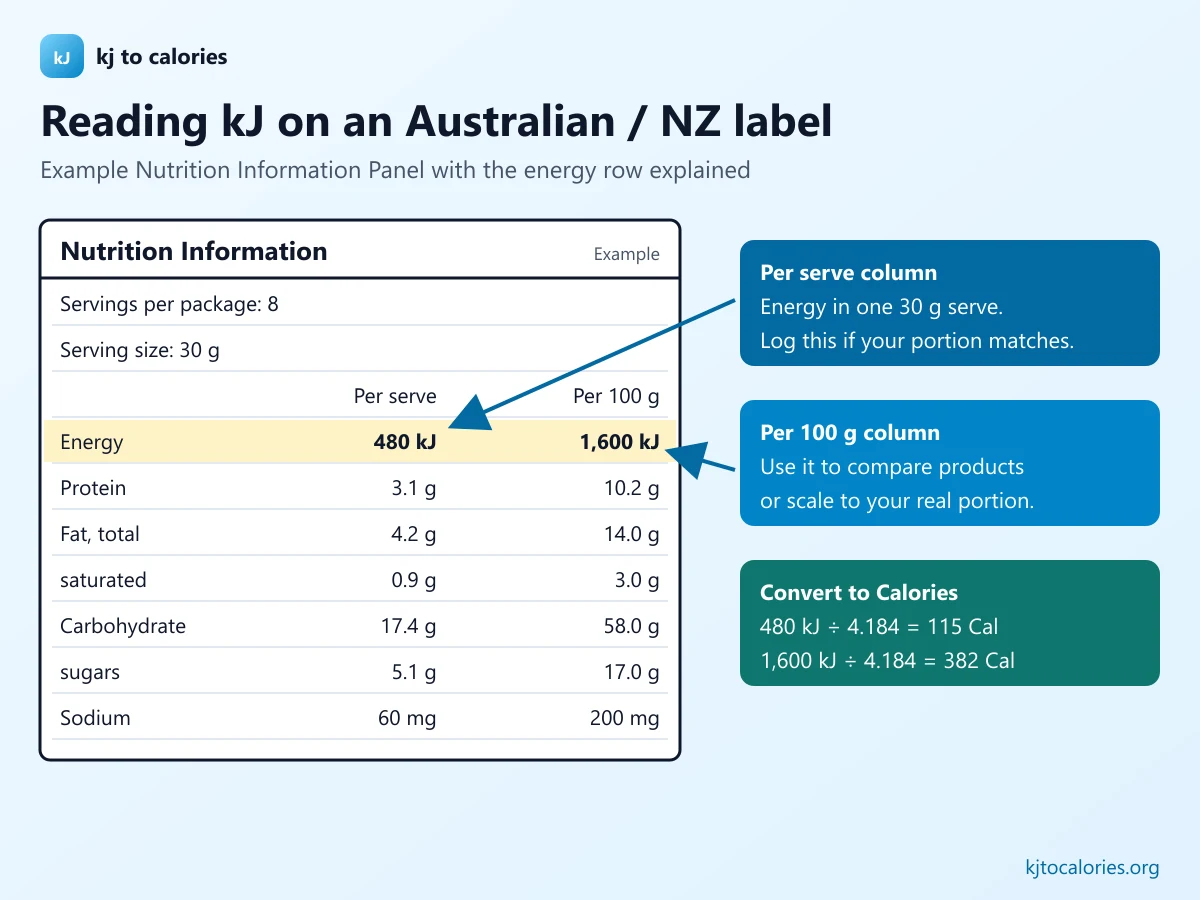
On labels in Australia, New Zealand, the UK, the EU and many other countries, energy is the first line of the nutrition information panel. It might say:
- Energy 850 kJ (Australia / New Zealand style)
- Energy 850 kJ / 203 kcal (UK / EU style)
- Calories 200 (US / Canada style, no kJ)
If there’s only a kJ figure and you think in Calories, divide by 4.184. If there’s only Calories and you think in kJ, multiply by 4.184.
Step 2: Choose The Right Column, Per Serve Or Per 100 g
Most non-US labels have two columns:
| Column | What it means | Use it for |
|---|---|---|
| Per serve | Energy in one serving, as defined by the manufacturer | Quick tracking when your portion matches the stated serve |
| Per 100 g (or 100 ml) | Energy in exactly 100 g of the product | Comparing products; calculating your real portion |
Always check the serving size printed at the top of the panel. A “serve” of cereal might be 30 g; a “serve” of ice cream might be 50 g. If you eat twice that, you eat twice the energy.
Step 3: Scale To Your Portion
If your portion differs from the stated serve, use the per-100 g figure:
Portion Formula
kJ in your portion = kJ per 100 g × grams eaten ÷ 100
Example: Granola, 1,850 kJ per 100 g. You pour 70 g.
1,850 × 70 ÷ 100 = 1,295 kJ, or 1,295 ÷ 4.184 = 310 Calories.
The label’s “per serve” figure (45 g = 833 kJ) would have undercounted by 462 kJ. The food label calculator does this sum for you, and kJ to calories for food has more worked product examples.
Step 4: Understand % Daily Intake
Many labels include a % Daily Intake (%DI) or Reference Intake (%RI) column. It shows how much of an average adult’s daily energy one serve provides:
- Australia and New Zealand: based on 8,700 kJ.
- UK and EU: based on 8,400 kJ / 2,000 kcal.
- US %DV: the energy reference is 2,000 Calories.
These are averages, not personal targets. If you need 7,000 kJ a day, a serve showing “10% DI” (870 kJ) is actually 12.4% of your day. Work out your own number with the daily kJ calculator.
Step 5: Read The Rest Of The Energy Story
Energy tells you how much fuel is in food, not whether it’s nutritious. Glance at the lines below it:
- Protein, fat, carbohydrate and fibre: the sources of the energy. (Fat has 37 kJ per gram; protein and carbohydrate 17 kJ.) See energy factors explained.
- Saturated fat, sugars and sodium: nutrients most people should limit.
- Fibre: most people should eat more.
Reading A US Nutrition Facts Panel
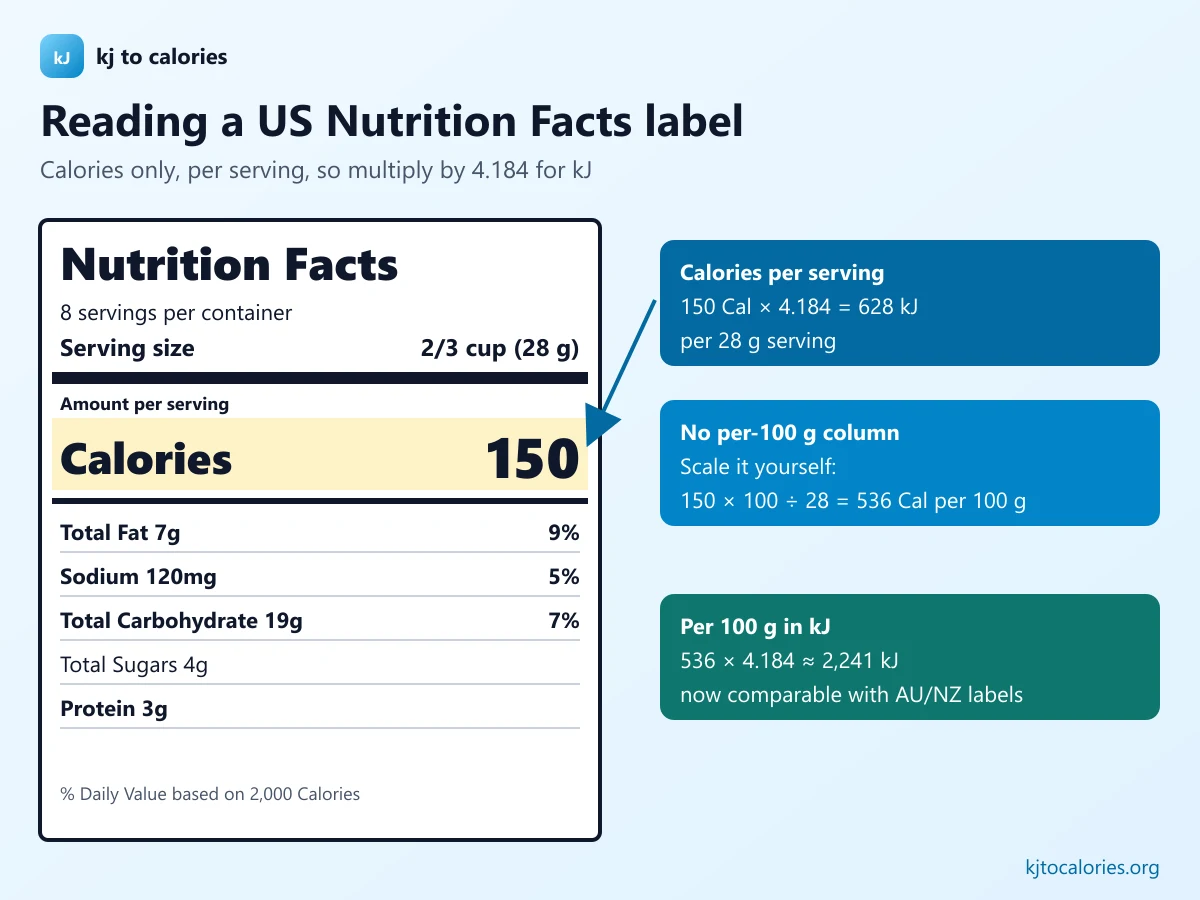
US labels look different:
- Calories appear in large type near the top, per serving only.
- The serving size is given in household units (e.g. “2/3 cup”) and grams.
- There’s usually no per-100 g column, so scale using the gram weight of a serving.
Example: A US snack says “Serving size 28 g, Calories 150”. Per 100 g that’s 150 × 100 ÷ 28 = 536 Calories, or about 2,241 kJ.
Reading A Dual kJ / kcal Label
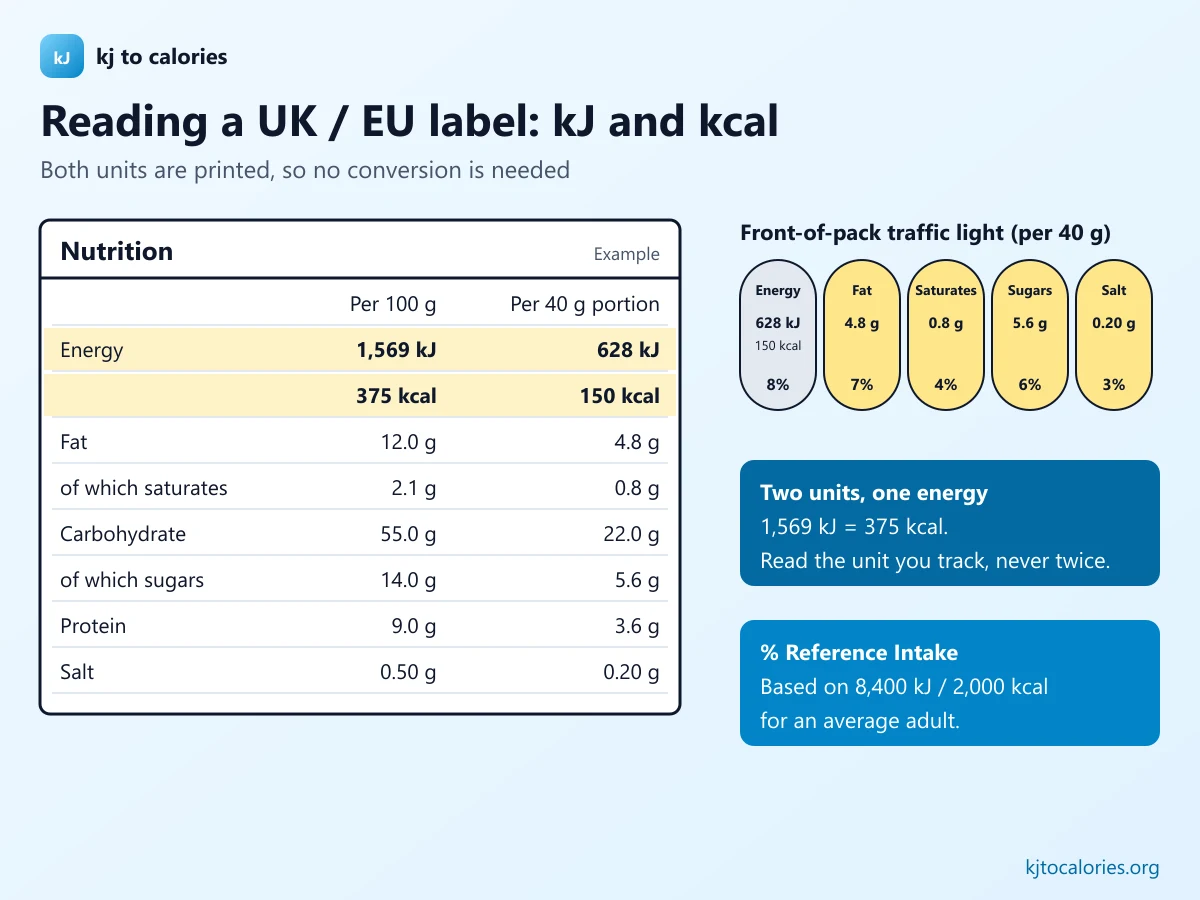
On UK and EU labels you’ll see both numbers side by side, for example Energy 1,569 kJ / 375 kcal per 100 g. Don’t convert again: just read whichever unit you use. The kJ figure is always the larger one.
Many UK products also have a front-of-pack traffic-light label that shows energy per portion and as a percentage of the 8,400 kJ reference intake.
Worked Example: Comparing Two Yoghurts
| Yoghurt A | Yoghurt B | |
|---|---|---|
| Energy per 100 g | 390 kJ | 540 kJ |
| Serving size | 170 g | 150 g |
| Energy per serve | 663 kJ | 810 kJ |
| Calories per serve | 158 kcal | 194 kcal |
Yoghurt B is about 38% more energy-dense, even though the serve is smaller.
Common Label-Reading Mistakes
- Tracking per serve when you ate the whole pack. Check “servings per package”.
- Using dry weights for cooked foods. Rice and pasta labels usually refer to uncooked product.
- Forgetting what you add: milk, oil, butter, sauces.
- Mixing units: adding kJ from one label to kcal from another.
- Treating %DI as your personal target.
Quick Checklist
- ✔ Found the energy row and its unit
- ✔ Checked serving size and servings per pack
- ✔ Used per-100 g for comparisons and real portions
- ✔ Converted once (if needed) with 4.184
- ✔ Added extras separately
FAQ
Where is kJ on a food label?
In the Energy row at the top of the nutrition information panel, usually listed per serve and per 100 g.
How do I convert kJ on a label to Calories?
Divide the kJ figure by 4.184. For example, 850 kJ ÷ 4.184 = 203 Calories.
What is %DI on a food label?
Percentage Daily Intake: how much of an average adult’s daily energy (8,700 kJ in Australia and New Zealand) one serve provides.
Why is per 100 g useful?
It lets you compare products fairly and calculate the energy in any portion size you actually eat.