Australian kJ to Calories Converter
Exercise times are estimates for a 70 kg adult.
On this page
Why Australians And New Zealanders Need A kJ To Calories Converter
Food in Australia and New Zealand is labelled in kilojoules (kJ), but most diet books, fitness apps and online recipes still count Calories. That mismatch is why “kJ to calories converter Australia” is one of the most searched food-energy questions in the region. The converter above uses the same factor as the food standards code: Calories = kJ ÷ 4.184.
A quick rule for shopping: divide the kJ by 4, then take off about 4%. A 1,000 kJ snack is roughly 240 Calories (exactly 239).
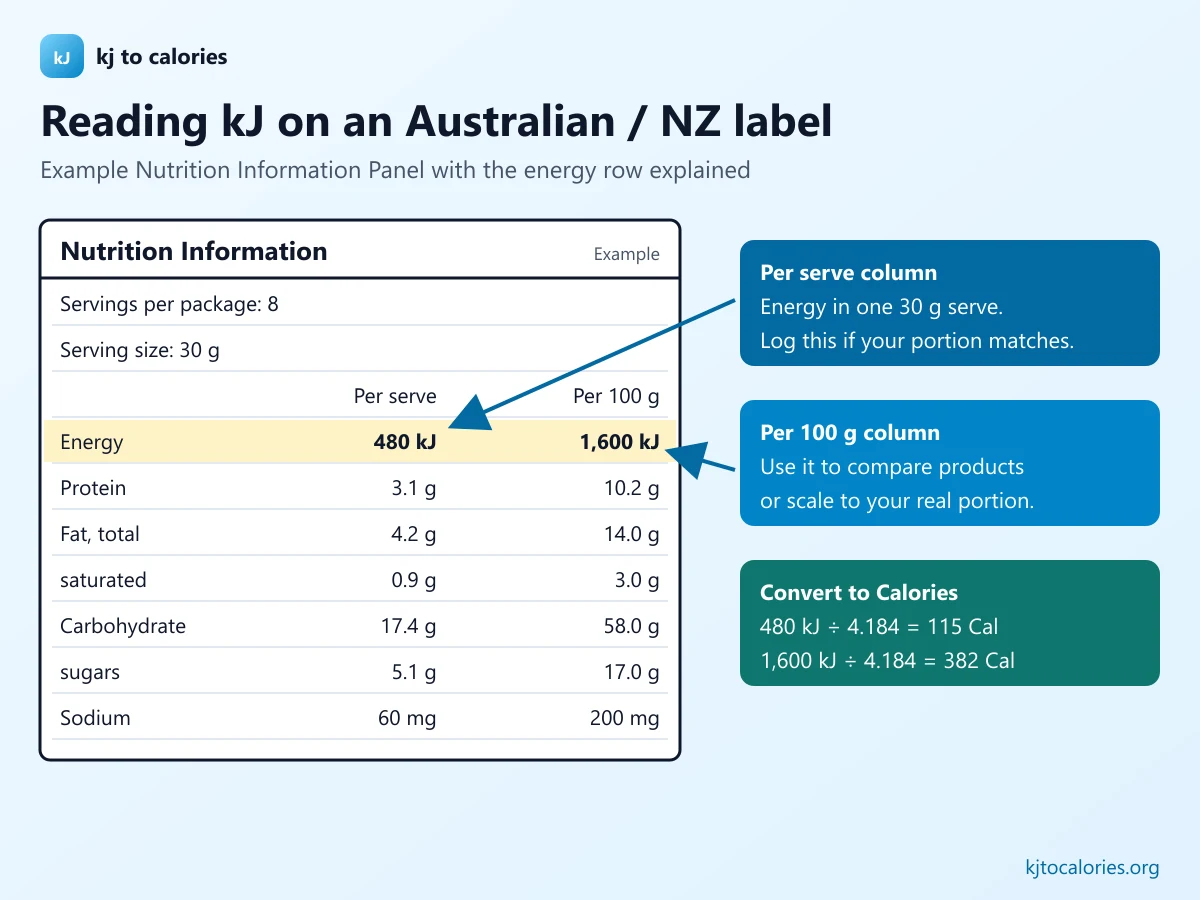
How Kilojoules Appear On Australian And NZ Food Labels
Australia and New Zealand share one food standards code, managed by Food Standards Australia New Zealand (FSANZ). Almost every packaged food must carry a Nutrition Information Panel (NIP), and the first row is always energy.
| Label feature | What it shows | How to use it |
|---|---|---|
| Energy per serve | kJ in one manufacturer-defined serve | Log it directly if your portion matches the serve |
| Energy per 100 g / 100 ml | kJ in exactly 100 g or 100 ml | Compare products, or scale to your real portion |
| Calories (optional) | Some brands add Cal in brackets | Already converted, don’t convert again |
| % Daily Intake (optional) | Share of 8,700 kJ per serve | Quick comparison, not a personal target |
| Health Star Rating (voluntary) | ½ to 5 stars on the front of pack | Compare similar products in the same category |
For a full walk-through, see how to read kJ on a nutrition label, or use the food label calculator to turn a per-100 g figure into your exact portion.
The 8,700 kJ Average Daily Intake
Labels in both countries base their “% Daily Intake” on an average adult diet of 8,700 kJ, which is about 2,079 Calories. It’s a reference number, not a recommendation, many people need more or less. Our guide to what 8,700 kJ means explains where it fits, and the daily kJ calculator gives you a personal figure.
| Daily intake | Calories | Who it might suit |
|---|---|---|
| 6,300 kJ | 1,506 kcal | Smaller, less active adults aiming to lose weight |
| 8,700 kJ | 2,079 kcal | The label reference “average adult” |
| 10,500 kJ | 2,510 kcal | Many moderately active men |
| 12,000 kJ | 2,868 kcal | Tall or very active adults |
Kilojoules On Menu Boards
Several Australian states and territories, including New South Wales, South Australia, the ACT, Queensland and Victoria: require large fast-food and snack chains to display kilojoules for standard menu items, along with the statement “The average adult daily energy intake is 8,700 kJ”. That makes it easy to compare a meal with your day, but only if you think in kilojoules.
Some quick menu-board conversions:
| Menu kJ | Calories | Share of 8,700 kJ |
|---|---|---|
| 1,200 kJ | 287 kcal | 14% |
| 2,000 kJ | 478 kcal | 23% |
| 3,000 kJ | 717 kcal | 34% |
| 4,000 kJ | 956 kcal | 46% |
| 5,000 kJ | 1,195 kcal | 57% |
See the full menus converted to Calories for McDonald’s, Hungry Jack’s and Subway.
New Zealand doesn’t have the same mandatory menu-board rules, so kJ information on NZ menus is less common, but packaged-food labels follow the same kJ rules as Australia.
Common Australian And NZ Foods In kJ And Calories
| Food | Serve | Kilojoules | Calories |
|---|---|---|---|
| Flat white, full-cream milk | regular | 628 kJ | 150 kcal |
| Wheat biscuit cereal (2) with milk | 30 g + 125 ml | 797 kJ | 191 kcal |
| Meat pie | 175 g | 1,820 kJ | 435 kcal |
| Sausage roll | 1 large | 1,548 kJ | 370 kcal |
| Toast with butter and yeast spread | 1 slice | 628 kJ | 150 kcal |
| Chocolate-coated cream biscuit | 1 biscuit | 397 kJ | 95 kcal |
| Beer, full strength | 375 ml | 649 kJ | 155 kcal |
| Beer, light | 375 ml | 418 kJ | 100 kcal |
Using Calorie-Based Apps With kJ Labels
If your tracking app counts Calories, either switch it to kilojoules or convert each label as you log it. Our guides cover MyFitnessPal, Apple Watch and other health apps, and tracking kilojoules in calorie apps explains the best set-up.
Why Australia Uses Kilojoules
Australia and New Zealand moved to metric units in the 1970s, and food energy followed the international (SI) unit, the joule. The history, and why the US still uses Calories, is in why Australia uses kilojoules.
Related Tools
- kJ to calories converter
- Calories to kJ converter
- Food label calculator
- Daily kJ calculator
- kJ to calories chart
- Install the converter app
FAQ
How do I convert kJ to Calories in Australia?
Divide the kilojoules on the label by 4.184. For example, 870 kJ ÷ 4.184 = 208 Calories. The converter at the top of this page does it instantly.
What is 8,700 kJ in Calories?
8,700 kJ is about 2,079 Calories, the average adult daily intake used on Australian and New Zealand labels.
Do Australian labels have to show Calories?
No. Energy must be shown in kilojoules; showing Calories as well is optional, which is why many packs only list kJ.
Is New Zealand the same as Australia for kJ labels?
Yes. Both countries follow the same food standards code, so NZ labels also show energy in kilojoules.
How many kJ should I eat a day in Australia?
It depends on your size, age and activity. 8,700 kJ is only an average; use the daily kJ calculator for a personal estimate.