Exercise Kilojoule Burn Calculator
Gross energy estimate: MET × 3.5 × body weight (kg) ÷ 200 per minute.
On this page
How Many Kilojoules Does Exercise Burn?
It depends on three things: what you’re doing, how long you do it, and how much you weigh. A heavier body uses more energy to move, so two people doing the same 30-minute jog can burn quite different amounts.
The calculator uses MET values (metabolic equivalents) from the Compendium of Physical Activities, the standard reference used in exercise science. One MET is roughly the energy you use sitting quietly. An activity rated 8 METs uses about eight times that.
Energy Burned Per Minute
kcal per minute = MET × 3.5 × body weight (kg) ÷ 200
kJ per minute = kcal per minute × 4.184
Kilojoules Burned In 30 Minutes
Here’s how much energy common activities use in half an hour at three different body weights.
| Activity | MET | 60 kg | 70 kg | 85 kg | 70 kg in kcal |
|---|---|---|---|---|---|
| Walking, casual (4 km/h) | 3.0 | 395 kJ | 461 kJ | 560 kJ | 110 kcal |
| Walking, moderate (5 km/h) | 3.5 | 461 kJ | 538 kJ | 653 kJ | 129 kcal |
| Hiking / uphill walking | 6.0 | 791 kJ | 923 kJ | 1,120 kJ | 221 kcal |
| Jogging (8 km/h) | 8.3 | 1,094 kJ | 1,276 kJ | 1,550 kJ | 305 kcal |
| Running (10 km/h) | 9.8 | 1,292 kJ | 1,507 kJ | 1,830 kJ | 360 kcal |
| Running (12 km/h) | 11.8 | 1,555 kJ | 1,814 kJ | 2,203 kJ | 434 kcal |
| Cycling, leisure | 4.0 | 527 kJ | 615 kJ | 747 kJ | 147 kcal |
| Cycling, moderate (16-19 km/h) | 6.8 | 896 kJ | 1,046 kJ | 1,270 kJ | 250 kcal |
| Swimming, moderate laps | 5.8 | 764 kJ | 892 kJ | 1,083 kJ | 213 kcal |
| Strength training, general | 3.5 | 461 kJ | 538 kJ | 653 kJ | 129 kcal |
| Yoga (hatha) | 2.5 | 329 kJ | 384 kJ | 467 kJ | 92 kcal |
| Dancing | 5.0 | 659 kJ | 769 kJ | 934 kJ | 184 kcal |
| HIIT / circuit training | 8.0 | 1,054 kJ | 1,230 kJ | 1,494 kJ | 294 kcal |
| Rowing machine, moderate | 7.0 | 923 kJ | 1,076 kJ | 1,307 kJ | 257 kcal |
| Tennis, singles | 8.0 | 1,054 kJ | 1,230 kJ | 1,494 kJ | 294 kcal |
| Gardening | 3.8 | 501 kJ | 584 kJ | 710 kJ | 140 kcal |
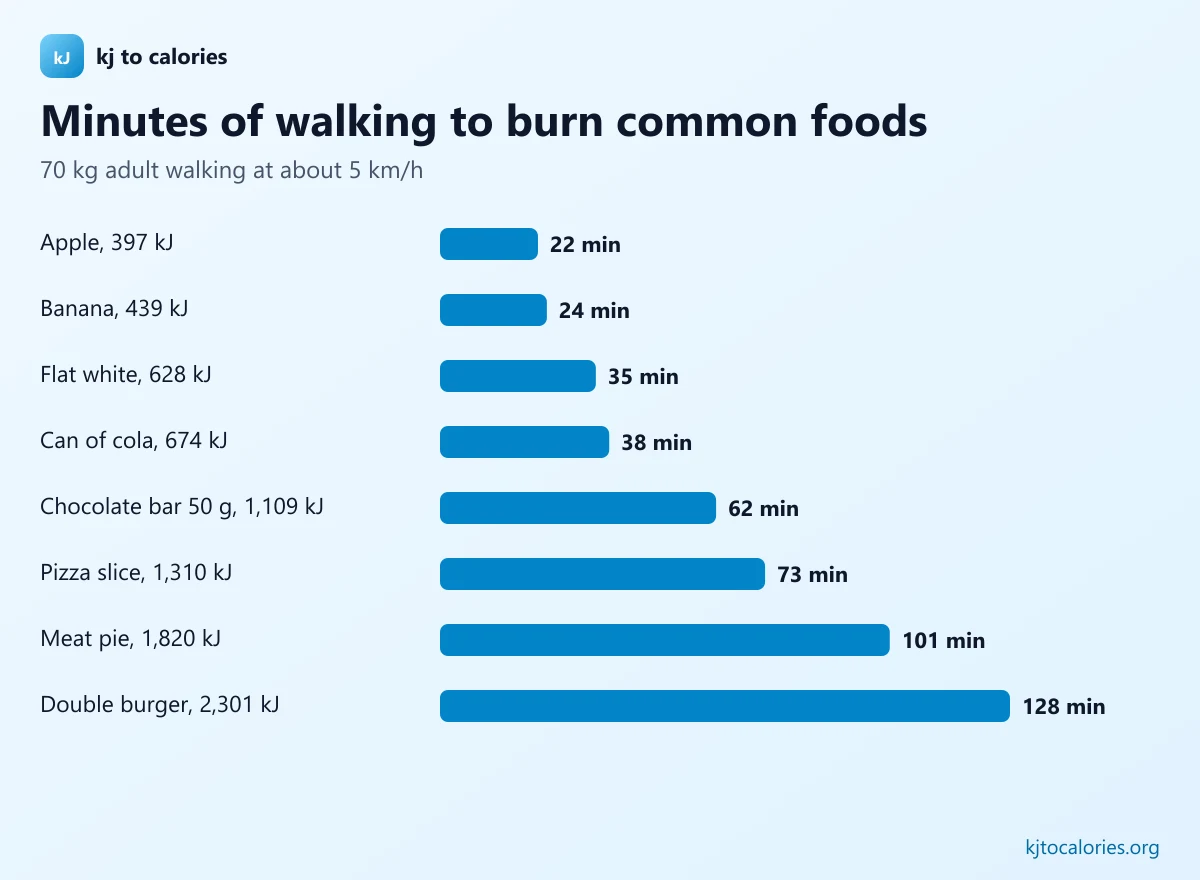
How Long Does It Take To Burn Off Food?
Converting food into “minutes of exercise” is one of the most eye-opening ways to understand kilojoules. For a 70 kg adult:
| Food | Kilojoules | Walking | Jogging | Cycling |
|---|---|---|---|---|
| Apple | 397 kJ | 22 min | 9 min | 11 min |
| Banana | 439 kJ | 24 min | 10 min | 13 min |
| Flat white (full-cream) | 628 kJ | 35 min | 15 min | 18 min |
| Can of regular cola | 674 kJ | 38 min | 16 min | 19 min |
| 50 g milk chocolate | 1,109 kJ | 62 min | 26 min | 32 min |
| Slice of pepperoni pizza | 1,310 kJ | 73 min | 31 min | 38 min |
| Meat pie | 1,820 kJ | 1 h 41 min | 43 min | 52 min |
| Double burger | 2,301 kJ | 2 h 8 min | 54 min | 1 h 6 min |
This isn’t meant to make anyone feel guilty about food. It shows that exercise is great for health but a slow way to “cancel out” energy: which is why most successful weight management focuses on both what you eat and how you move.
Net Vs Gross Kilojoules
The numbers above are gross energy: everything you burn during the activity, including the energy you’d have used anyway just being alive. For a 70 kg adult that background is about 5 kJ (1.2 kcal) a minute. If you want the extra energy exercise costs you, the net burn, subtract about 1 MET’s worth:
Net kJ ≈ (MET − 1) × 3.5 × weight ÷ 200 × minutes × 4.184
For a 30-minute walk at 5 km/h and 70 kg that’s about 384 kJ extra, rather than 538 kJ gross. Fitness trackers vary in which one they report, “active Calories” is usually closer to net.
Walking: kJ Per Step And Per Kilometre
Walking is the world’s most popular exercise, so it’s worth knowing the rough numbers. A 70 kg adult walking at a steady pace uses about 200-230 kJ per kilometre (roughly 50-55 kcal), and 10,000 steps: roughly 7-8 km, burns about 1,500 to 1,720 kJ (360 to 410 kcal) gross. Read more in our guide to kJ burned walking 10,000 steps.
Cycling: Why Your Bike Computer Shows kJ
If you ride with a power meter, your head unit reports work done in kilojoules. Conveniently, because your body is only about 20-25% efficient at turning food energy into pedal power, 1 kJ on the bike ≈ 1 Calorie of food energy burned. So a 1,000 kJ ride costs you roughly 1,000 Calories, about 4,184 kJ of food energy. We explain the maths in cycling kJ vs Calories.
How Accurate Are Exercise kJ Estimates?
MET-based numbers are good averages, but your personal burn can be 10-20% higher or lower. Fitness level, technique, terrain, wind, temperature and body composition all play a part. Wrist-worn trackers estimate from heart rate and movement and have their own errors, especially for strength training.
Use estimates to compare activities and plan roughly, not to calculate precisely how much extra food you’ve “earned”.
Related Tools
- kJ to calories converter
- Daily kJ calculator
- Food kJ chart
- kJ burned walking 10,000 steps
- Cycling kJ vs Calories
- Active kJ to calories burned
- Change Apple Watch to Calories
Exercise Kilojoules FAQ
How many kJ does walking burn?
A 70 kg adult burns about 460-540 kJ in 30 minutes of casual to moderate walking, or roughly 200-230 kJ per kilometre.
How many kJ does running burn?
A 70 kg adult burns about 1,275-1,800 kJ in 30 minutes of running, depending on pace. Heavier runners burn more.
How many kJ do I burn doing nothing?
Your body burns energy all day just to stay alive, for most adults 5,000-8,000 kJ a day at complete rest, or roughly 3.5-5.5 kJ per minute.
How long does it take to burn 1,000 kJ?
For a 70 kg adult: about 56 minutes of walking, 24 minutes of jogging or 29 minutes of moderate cycling.
Should I eat back the kilojoules I burn exercising?
If you’re trying to lose weight, eating back all of them usually cancels out your deficit, especially as trackers often overestimate. Many people eat back a portion, or build activity into their daily target from the start.
What does MET mean?
MET stands for metabolic equivalent of task. 1 MET is the energy you use at rest; an 8-MET activity uses about eight times as much.