If you ride with a power meter, your bike computer reports work in kilojoules: 600 kJ for an easy hour, 1,500 kJ for a hard two-hour ride. Many cyclists treat that number as Calories burned, and, remarkably, that’s roughly right.
Rule of thumb: 1 kJ of work on the pedals ≈ 1 Calorie (kcal) of food energy burned.
On this page
Why The Numbers Line Up
Two facts combine:
- 1 Calorie = 4.184 kJ. So a Calorie is about four times bigger than a kilojoule.
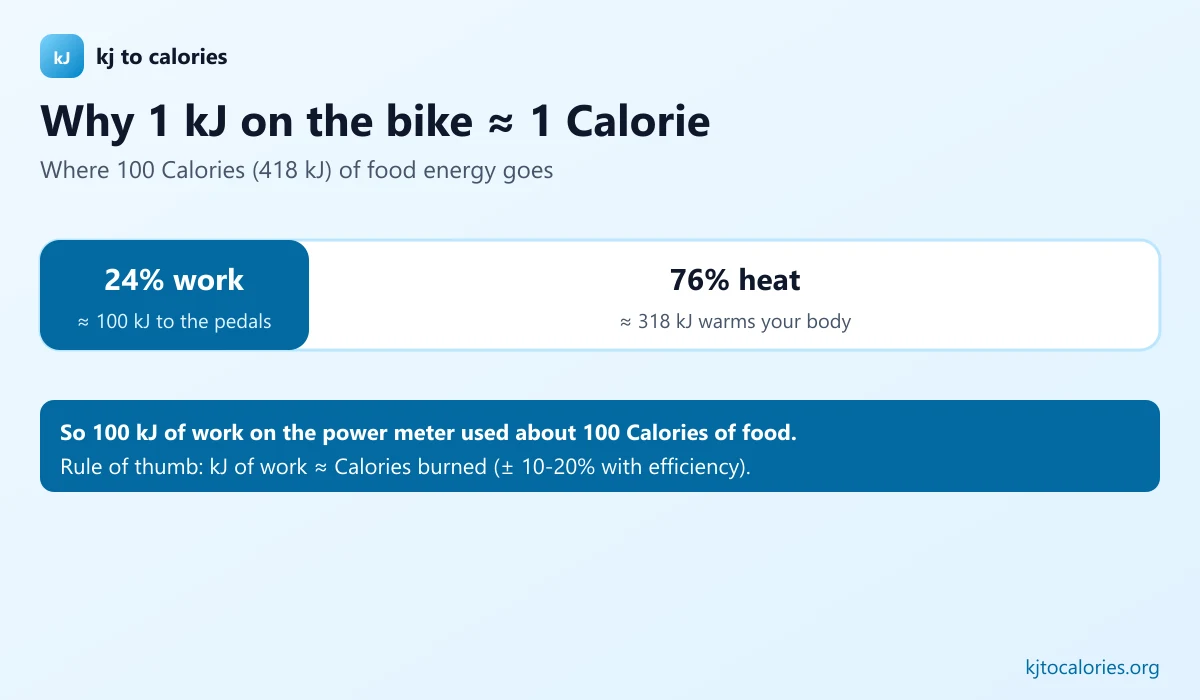
- Your body is about 20-25% efficient at turning food energy into mechanical work on the bike. The rest becomes heat.
If you’re 24% efficient, producing 1 kJ of work requires 1 ÷ 0.24 = 4.17 kJ of food energy, which is almost exactly 1 Calorie. The two factors cancel out.
| Gross efficiency | Food energy for 1 kJ of work | In Calories |
|---|---|---|
| 20% | 5.00 kJ | 1.20 kcal |
| 22% | 4.55 kJ | 1.09 kcal |
| 24% | 4.17 kJ | 1.00 kcal |
| 25% | 4.00 kJ | 0.96 kcal |
Worked Example
A 90-minute ride with an average power of 180 watts:
- Work = 180 W × 5,400 s = 972,000 J = 972 kJ
- Food energy used ≈ 972 Calories (about 4,070 kJ)
When The Rule Breaks Down
- Less efficient riders (beginners, very high cadence, poor bike fit) may burn 10-20% more than the rule suggests.
- Very short, very hard efforts rely on anaerobic energy and don’t follow the same efficiency.
- Estimated power (from speed and gradient, without a power meter) can be far off, especially with wind.
KJ On The Bike Vs kJ On A Food Label
Here’s the trap: the bike’s “kJ” is mechanical work, while a food label’s “kJ” is food energy. They’re the same unit but measure different things. A 1,000 kJ ride uses about 4,184 kJ of food energy: roughly half an 8,700 kJ day. Don’t compare the bike number with food labels directly.
Fuelling Rides In kJ
Endurance riders often aim to replace a portion of what they burn during long rides, commonly 30-90 g of carbohydrate per hour depending on duration and intensity. That’s about 510-1,530 kJ of food energy an hour. Use the macros to kJ calculator to check your ride snacks and the food kJ chart for everyday options.
Peloton, Zwift And Bike Computers
The same rule applies whatever device reports your ride:
| Device or app | What it shows | How to convert |
|---|---|---|
| Peloton bike | Output in kJ (mechanical work) | Output kJ ≈ Calories burned |
| Zwift, TrainerRoad, Rouvy | Work in kJ from your power data | Work kJ ≈ Calories burned |
| Garmin, Wahoo, Hammerhead head units | Work in kJ with a power meter | Work kJ ≈ Calories burned |
| Gym bikes without a power meter | “kJ” or “Calories” estimated from speed and resistance | Treat as a rough estimate |
Peloton output kJ to Calories: a 30-minute class with an output of 300 kJ burned roughly 300 Calories (about 1,250 kJ of food energy), not 72 Calories, which is what you’d get by dividing 300 by 4.184. That division is only right for food energy, not for mechanical work. For other exercise readings, see active kJ to Calories burned.
FAQ
Is 1 kJ on my bike computer equal to 1 Calorie?
Approximately. Because the body is about 24% efficient and a Calorie is 4.184 kJ, 1 kJ of work costs roughly 1 Calorie of food energy.
How many Calories is a 1,000 kJ ride?
About 1,000 Calories (roughly 4,200 kJ of food energy), give or take 10-20% depending on your efficiency.
Why doesn’t my watch agree with my power meter?
Watches estimate energy from heart rate and other data; power meters measure work directly. Power-based estimates are usually more reliable for cycling.