Every kilojoule on a food label comes from a handful of nutrients. Know how much energy each one provides per gram, and you can check a label, understand why some foods are so energy-dense, and build meals that match your targets.
On this page
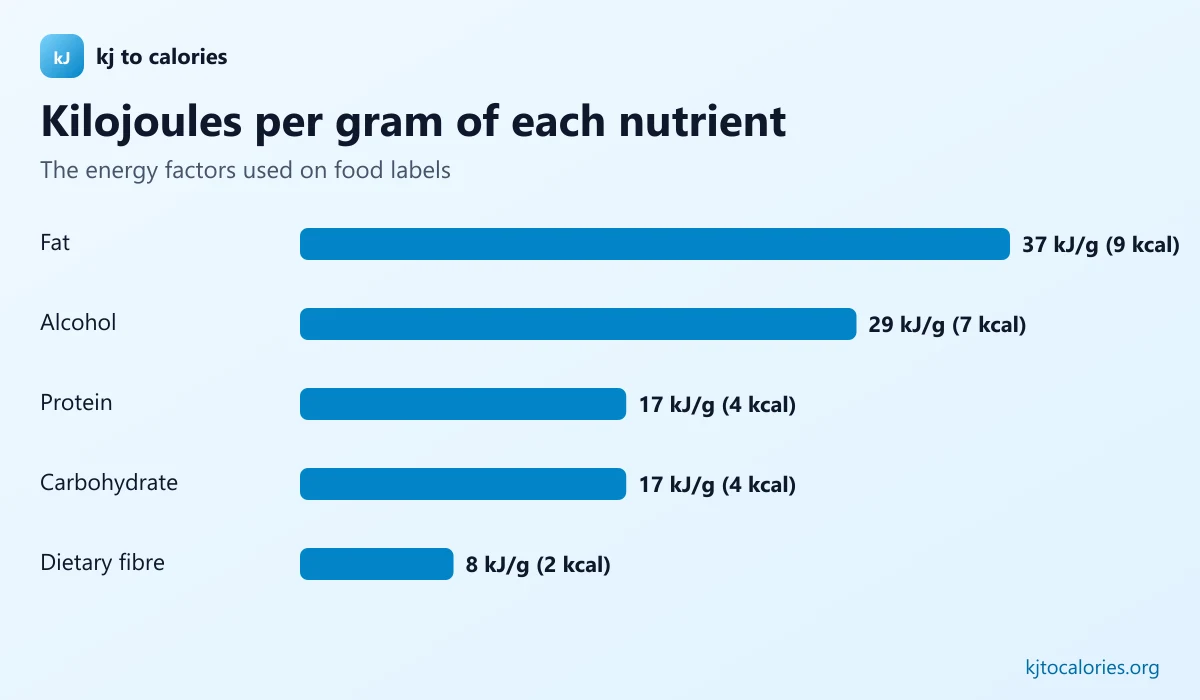
The Energy Factors
| Nutrient | kJ per gram | kcal per gram |
|---|---|---|
| Fat | 37 | 9 |
| Alcohol | 29 | 7 |
| Protein | 17 | 4 |
| Carbohydrate (available) | 17 | 4 |
| Dietary fibre | 8 | 2 |
| Organic acids | 13 | 3 |
Water, vitamins and minerals provide no energy at all.
Where Do These Numbers Come From?
In the late 1800s the American chemist Wilbur Atwater burned foods in a bomb calorimeter to measure their total energy, then measured how much of it people actually absorbed and used. He found that, on average, digestible protein, fat and carbohydrate supplied about 4, 9 and 4 kilocalories per gram. These Atwater factors are still the basis of food labels more than a century later.
The kilojoule factors (17, 37, 17) are the metric versions, rounded to whole numbers. Because both sets are rounded, calculating in kJ and then converting to kcal can give a slightly different answer from calculating in kcal directly, typically 1-3%.
Why Fat Is So Energy-Dense
Fat molecules are rich in carbon-hydrogen bonds and contain very little oxygen, so there’s more energy to release when your body oxidises them. Carbohydrates and proteins are already partly “oxidised”, so each gram yields less. That’s why:
- 1 tablespoon of oil (14 g fat) ≈ 518 kJ by the 37 kJ/g factor (measured values for olive oil are about 498 kJ, as listed in our food chart)
- 1 tablespoon of sugar (12.5 g carbohydrate) ≈ 213 kJ
Same spoon, more than twice the energy.
How To Calculate Energy From A Label
Energy Formula
kJ = protein × 17 + fat × 37 + carbohydrate × 17 + fibre × 8 + alcohol × 29
Example: A muesli bar has 3 g protein, 5 g fat, 20 g carbohydrate and 2 g fibre.
- Protein: 3 × 17 = 51 kJ
- Fat: 5 × 37 = 185 kJ
- Carbohydrate: 20 × 17 = 340 kJ
- Fibre: 2 × 8 = 16 kJ
- Total: 592 kJ ≈ 141 Calories
Try your own numbers with the macros to kJ calculator.
Why Your Calculation Might Not Match The Label Exactly
- Rounding. Labels round each nutrient, often to one decimal place.
- Different carbohydrate definitions. “Available carbohydrate” excludes fibre; US “total carbohydrate” includes it.
- Fibre treatment. Countries count fibre energy differently.
- Natural variation. Two batches of the same product aren’t identical. Regulators allow some tolerance.
Differences of a few percent are normal and not worth worrying about.
Using Energy Factors To Plan Meals
Once you know the factors, you can work backwards from a kJ target. On an 8,000 kJ day:
| Macro split | Protein | Fat | Carbohydrate |
|---|---|---|---|
| Balanced (20 / 30 / 50%) | 1,600 kJ = 94 g | 2,400 kJ = 65 g | 4,000 kJ = 235 g |
| Higher protein (30 / 30 / 40%) | 2,400 kJ = 141 g | 2,400 kJ = 65 g | 3,200 kJ = 188 g |
| Lower carb (25 / 45 / 30%) | 2,000 kJ = 118 g | 3,600 kJ = 97 g | 2,400 kJ = 141 g |
Alcohol: Nearly As Dense As Fat
At 29 kJ per gram, alcohol provides energy without nutrients. A standard drink in Australia contains 10 g of alcohol, 290 kJ from the alcohol alone. Read more in our guide to kilojoules in alcohol.
FAQ
How many kJ in a gram of protein?
17 kJ (4 kcal).
How many kJ in a gram of fat?
37 kJ (9 kcal).
How many kJ in a gram of carbohydrate?
17 kJ (4 kcal) for available carbohydrate.
How many kJ in a gram of fibre?
8 kJ (2 kcal) under Australian, New Zealand, UK and EU labelling rules.
How many kJ in a gram of alcohol?
29 kJ (7 kcal).