Pick up a snack in Sydney and the label says kJ. In New York it says Calories. In London or Berlin it says both. The food isn’t different, the history is.
On this page
Two Units For The Same Thing
Energy can be measured in joules or calories, and they convert exactly: 1 kcal = 4.184 kJ. The calorie came first, in the 1800s, as a heat unit based on warming water. The joule arrived later as part of a single, consistent system of scientific units.
The Metric System Changes The Rules
In 1960 the International System of Units (SI) was adopted, with the joule as the official unit of energy. Scientific bodies recommended phasing out the calorie. Countries that went through full metrication over the following decades, replacing miles with kilometres, pounds with kilograms and Fahrenheit with Celsius, often switched food energy to kilojoules at the same time.
- Australia and New Zealand made the change during their metric conversions in the 1970s. Today their joint food standards require energy in kilojoules; Calories may be shown too but are optional.
- South Africa also labels energy in kilojoules.
- China labels energy in kilojoules on its nutrition facts panels.
Why The US Kept Calories
The United States never fully adopted metric units for everyday life, and the Calorie was already deeply embedded in American nutrition science, education and marketing. US Nutrition Facts panels show Calories, and Canada, whose labels are closely aligned with the US format, does the same.
Because so many diet books, apps, gadgets and websites come from the US, the Calorie spread worldwide as the “default” unit of dieting, even in kilojoule countries.
Why The UK And EU Show Both
The European Union requires nutrition labels to show energy in both kJ and kcal. It’s a practical compromise: the SI unit for science and regulation, and the familiar kcal that consumers recognise. The UK kept the same approach.
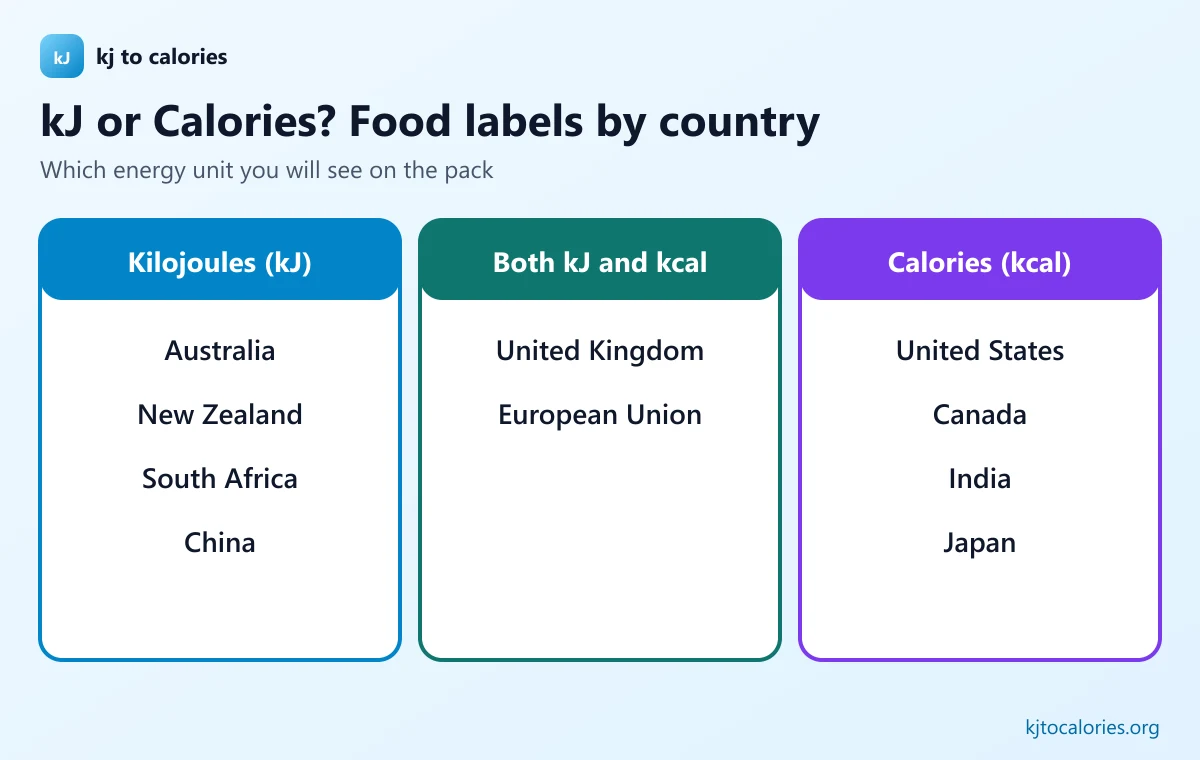
Which Unit Each Country Uses
| Country / region | Energy unit on food labels | Typical reference day |
|---|---|---|
| Australia & New Zealand | kJ required; kcal optional | 8,700 kJ |
| United Kingdom | kJ and kcal (both required) | 8,400 kJ / 2,000 kcal |
| European Union | kJ and kcal (both required) | 8,400 kJ / 2,000 kcal |
| United States | Calories (kcal) | 2,000 Calories |
| Canada | Calories (kcal) | 2,000 Calories |
| South Africa | kJ | varies by product type |
| China | kJ | 8,400 kJ |
| India | kcal | 2,000 kcal |
| Japan | kcal | varies by age and sex |
What It Means For You
| If you… | Tip |
|---|---|
| Live in a kJ country and use a Calorie app | Switch the app to kJ if it allows, or convert your daily target once |
| Buy imported products | Check which unit the label uses before comparing |
| Follow a Calorie-based diet plan | Convert the daily total to kJ (× 4.184) and track in kJ |
| Travel between countries | Remember 1,000 kJ ≈ 240 Calories |
Our kJ to calories converter and calories to kJ converter handle any number instantly, and the Australia & NZ converter explains local labels and menu boards.
Will The World Ever Agree?
Probably not soon. Scientists and regulators use joules; consumers in many countries are used to Calories. Dual labelling, like in the EU, may be the most realistic long-term answer. Until then, a quick conversion does the job.
FAQ
Why does Australia use kJ instead of Calories?
Australia adopted the metric (SI) system, in which the joule is the unit of energy. Food standards in Australia and New Zealand require energy on labels to be shown in kilojoules.
Does the UK use kJ or Calories?
Both. UK and EU nutrition labels show energy in kJ and kcal side by side.
Is the kilojoule more accurate than the Calorie?
No. They’re different units for the same quantity and convert exactly (1 kcal = 4.184 kJ).